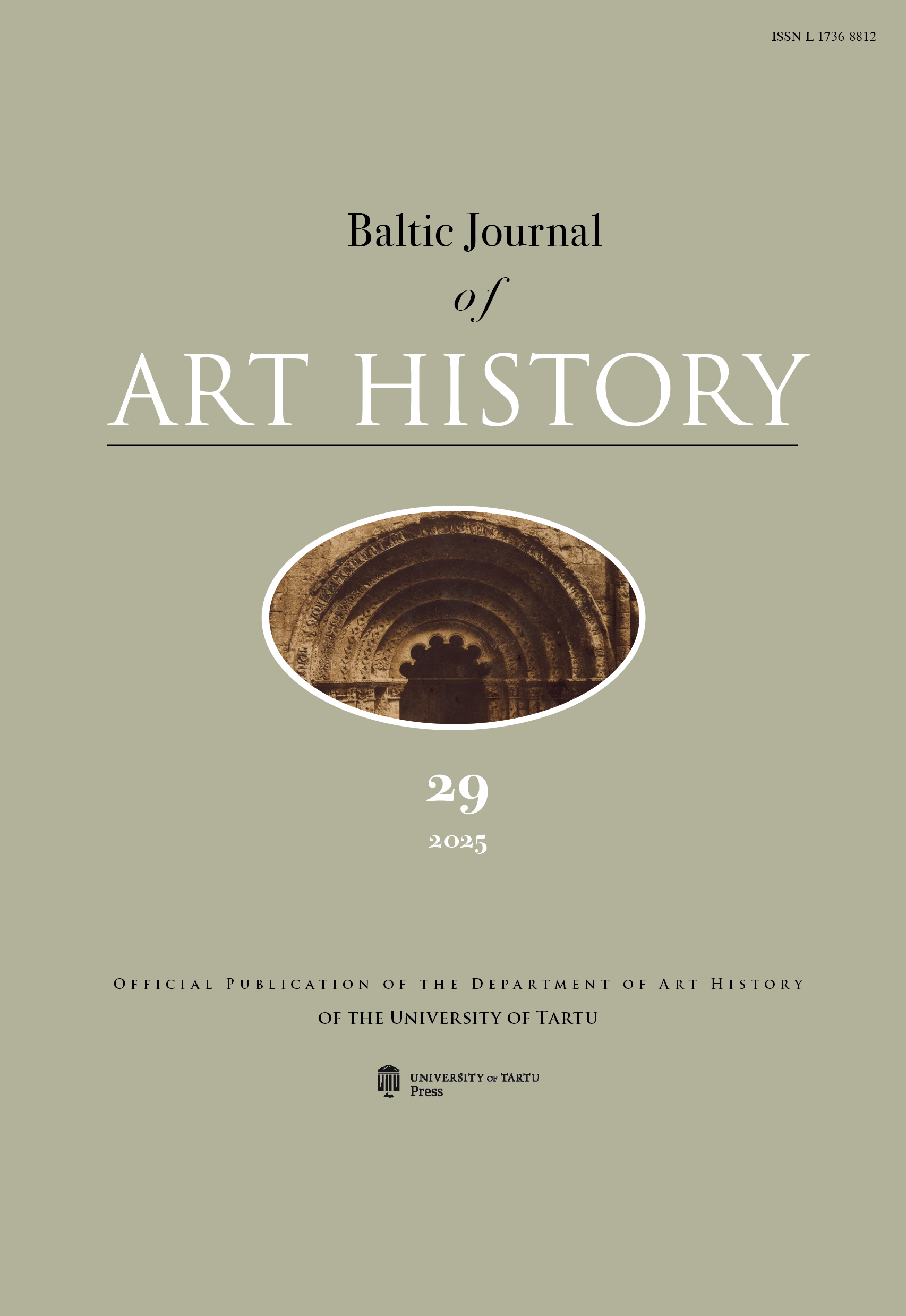
Photography and Heritage Documentation
DOI:
https://doi.org/10.12697/BJAH.2025.29.04Keywords:
photography, cultural heritage, heritage documentation, conservation and restoration, authenticityAbstract
The past is always irretrievably lost; nevertheless, we are left with our
heritage and photographs. In some cases, the two may also coincide.
On one hand, photographs themselves form part of our heritage, and
on the other hand, they are used to document our heritage. In this
article, I discuss how photography affects our engagement with the
past, shapes our understanding of the past, and recreates the past in
the present day. Photography is instrumental in shaping concepts and
practices central to many approaches to heritage. Examples can be
considered in this article of heritage presentation and interpretation,
as well as surveying and archiving processes. Documentation is an
integral part of heritage preservation, conservation, and restoration.
Since all objects can be considered as sources of information, the
preservation of heritage can also be viewed informationally. Since
its introduction, photography has actively participated in the process
of defining heritage and also in its institutionalization. Heritage,
regardless of its location, is easier to grasp and handle in visual form. The use of photography significantly changed the way the
general public experienced architecture. Through photographs,
distant objects suddenly became closer. The circle of individuals
who had visual knowledge of architecture increased noticeably.
Photography contributed significantly to the introduction of
heritage objects and thus to the broader use of the term “heritage”
itself. Today, conservation/restoration can no longer be imagined
without photography. Again, this is not something particularly
surprising, since photography was developed in addition to the
previously used methods of visual representation. It must be
recognized that photography helped make the describing and
surveying of monuments more accurate. Photography did not
bring a radical change to the documentation of monuments, but
was smoothly integrated with visual practices that had been in use
until that day in age. Photography also plays an important role in
the theoretical discussion of conservation/restoration. The central
problem of conservation and restoration is the question of object
authenticity. Photography’s association, whether apparent or not,
with nature and objectivity allowed it to be used to support various
theoretical concepts. Obviously, the relationship between heritage
and photography is not unilateral or clearly defined; it is a complex
interaction between multifaceted phenomena.
Downloads