
Introduction
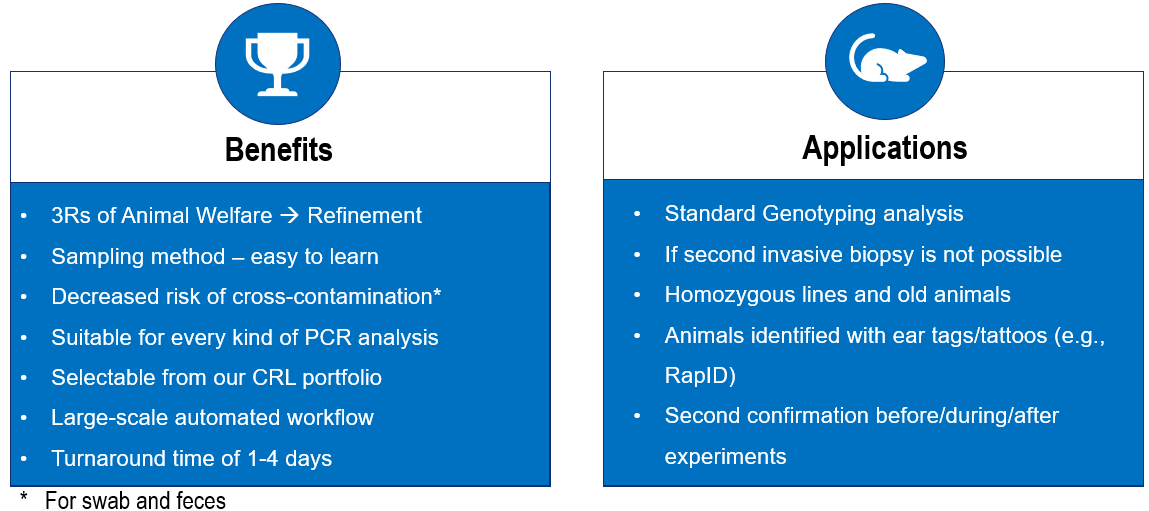
The Charles River 3Rs Mission strives to advance sci-ence by improving laboratory techniques in line with the 3Rs principle, introduced by Russell and Burch (1959), and focuses on enhancing animal well-being. The 3Rs are: Replacement - avoiding or replacing the use of animals, Reduction – minimizing number of animals and Refinement – minimizing pain, stress and suffering. In research with genetically modified mice, which involves genotyping using invasive ear or tail biopsies in 92% of cases (Mazlan et al. 2014), there is a growing shift towards non-invasive sampling techniques such as oral swabs, or collecting hair or feces. Our EU Charles River genetic testing laboratory has successfully tested and proven the efficacy of genotyping using oral swabs and hair from rodents, aligning with the 3Rs principle and European regulations. The advantages of using non-invasive methods, like oral swabs and hair instead of biopsies are shown in Figure 1 below.
Methods
Housing and husbandry: The genetically modified
mice were kept in stable groups within an isolator, under a
12:12-hour light/dark cycle, with temperatures ranging from
20-24°C and humidity levels between 45-65%. The mice were bred
and raised under micro-biologically defined conditions
(specific-pathogen-free(SPF) status according to FELASA
standard) and pro-vided with sterilized food pellets and water
ad libitum.Cage enrichment included cardboard rodent houses
orplay tunnels, wooden gnaw sticks and paper tissue.
Vet-erinarians and animal technicians ensured animal welfare
daily in accordance with national and internationallaws and
guidelines for the care and use of laboratoryanimals.
Research Conditions: For the data represented
here, both male and female mice from different trans-genic lines
were used. Due to animal well-being and the size of the swab
head, all animals were at least 16 days old before oral swab and
hair follicle samples were taken. Several swab-types were tested
in terms of the cotton head size and surface structure. Based on
the initial testing results, we identified the most effective
swab type for achieving optimal genotyping results. A thorough
sampling procedure is important to acquire sufficient animal
tissue for further processing.
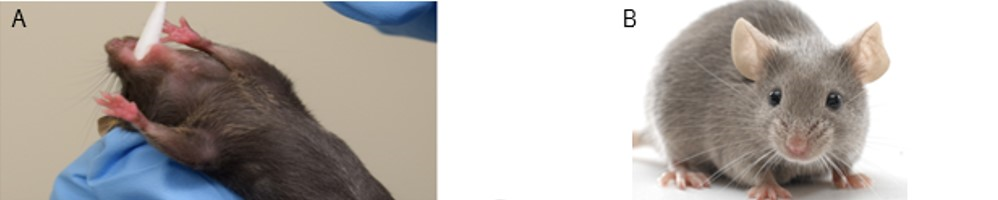
Sampling: Oral swab samples were taken from
mice, as shown in Figure 2. The swabs were autoclaved and
brought into the animal barrier facility according to standard
procedures. Mice were securely scruffed and the swab was twirled
around for 5-19 seconds to collect samples from the inside of
the cheek. Swabbing was done carefully to avoid hurting the
mice. Hair folli-cle samples were obtained by carefully plucking
a small amount of hair (10-20 hairs). After sampling, mice were
placed back into their cages. The oral swabs were left to dry
before placing each swab and hair sample into in-dividual tubes.
Surplus tissue (ear) from individual ani-mal identification was
used for routine genotyping and as a control. Finally, the
samples were shipped to the genotyping facility. All samples
were taken at AAALAC accredited CRL sites according to animal
welfare rules and guidelines.
Processing: Throughout the whole processing
work-flow, samples were kept in a 96-well format to avoid
potential mix up and to enable the processing of large number of
samples.
Lysis and DNA extraction: The oral swabs were
incubated in lysis buffer for 2h at 56°C. Hair and ear biopsies
were incubated under the same conditions but overnight. DNA was
extracted using Solid Phase Reversible Immobilization (SPRI)
technology. Purified DNA was stored at +4°C (short term) until
PCR analyses.
Polymerase Chain Reaction (PCR) and analysis of
results:
DNA extracted from the samples (oral swabs, hair and biopsies)
was subjected to either conventional PCR and analysis using
capillary gel electrophoresis (CE) (LabChip GX Touch, Perkin
Elmer) or real-time PCR (quantitative PCR and endpoint analysis)
using StepOne Cycler (ThermoFisher Scientific). Slight-ly
adapted conditions were established if needed e.g. increased
number of PCR cycles, template or primer concentration. Results
from conventional and real-time PCR were analyzed and compared
among the different sample types.
Results
1. Oral swab genotyping - Suitable for every kindof
PCR:
Oral swabs taken from transgenic lines (KO,KI, etc.) were
subjected to conventional PCR with am-plicons ranging from 100
to 1500 bp in length (Fig-ure 3A) and to real-time Endpoint
analysis (Figure 3B)and zygosity testing (qPCR) for transgenic
lines. In ourstudy we could show that >98% of oral swab
samplesled to clear results. Furthermore, >99% of the
resultsfrom oral swabs matched those from correspondingear
biopsies.
2. Shipment and Storage conditions for oralswab – (RT (+
20°C), + 4°C and – 20°C):
The ro-bustness of oral swabs genotyping in terms of ship-ment
and storage time/condition were tested for up to 25 days using
capillary gel electrophoresis. The percentage ratio of the PCR
amplicon in ng/μl for bi-opsies versus oral swabs is shown in
Figure 4. Signals could be detected up to 18 days after sampling
if the oral swabs were shipped and stored at RT (+20°C). The
best results were obtained when the samples were stored and
shipped at -20°C. Visible signals and eval-uable results were
also detected at +4°C up to 25 days after sampling.
3. Swabs versus Hair:
In this study we developeda simple, economic and efficient
strategy to extract DNA from hair follicles of mice which are
suitable for genotyping. When comparing oral swab and hair
fol-licle samples, we were able to demonstrate consistent
genotyping results from hair follicles.
Conclusion
In accordance with the 3Rs principle, we have opti-mized and expanded non-invasive genotyping meth-ods for mice within our automated workflow. This approach involves the collection of oral swabs or hair follicles, and provides an alternative to invasive biop-sies, particularly in cases where biopsies are prohibited (e.g., animals with ear tags or tattoos) or a secondary bi-opsy is not feasible. Non-invasive sampling serves as an appropriate substitute for invasive biopsies, significant-ly reducing stress and pain. These techniques are appli-cable to mice aged over 16 days. In addition, these sam-ple types, like standard biopsies, can be processed on a large scale in an automated workflow and are therefore an equivalent alternative for routine genotyping.
References
- Mazlan, N.H.B., Salesansky, N.L., Burn, C.C., Wells, D.J., (2014). Mouse identification methods and potentialwelfare issues: a survey of current practice in the UK.Animal Technology and Welfare. 13(1), 1-10
- Russell, W.M.S., Burch, R.L., (1959). The principles of humane experimental technique. London: Methuen.