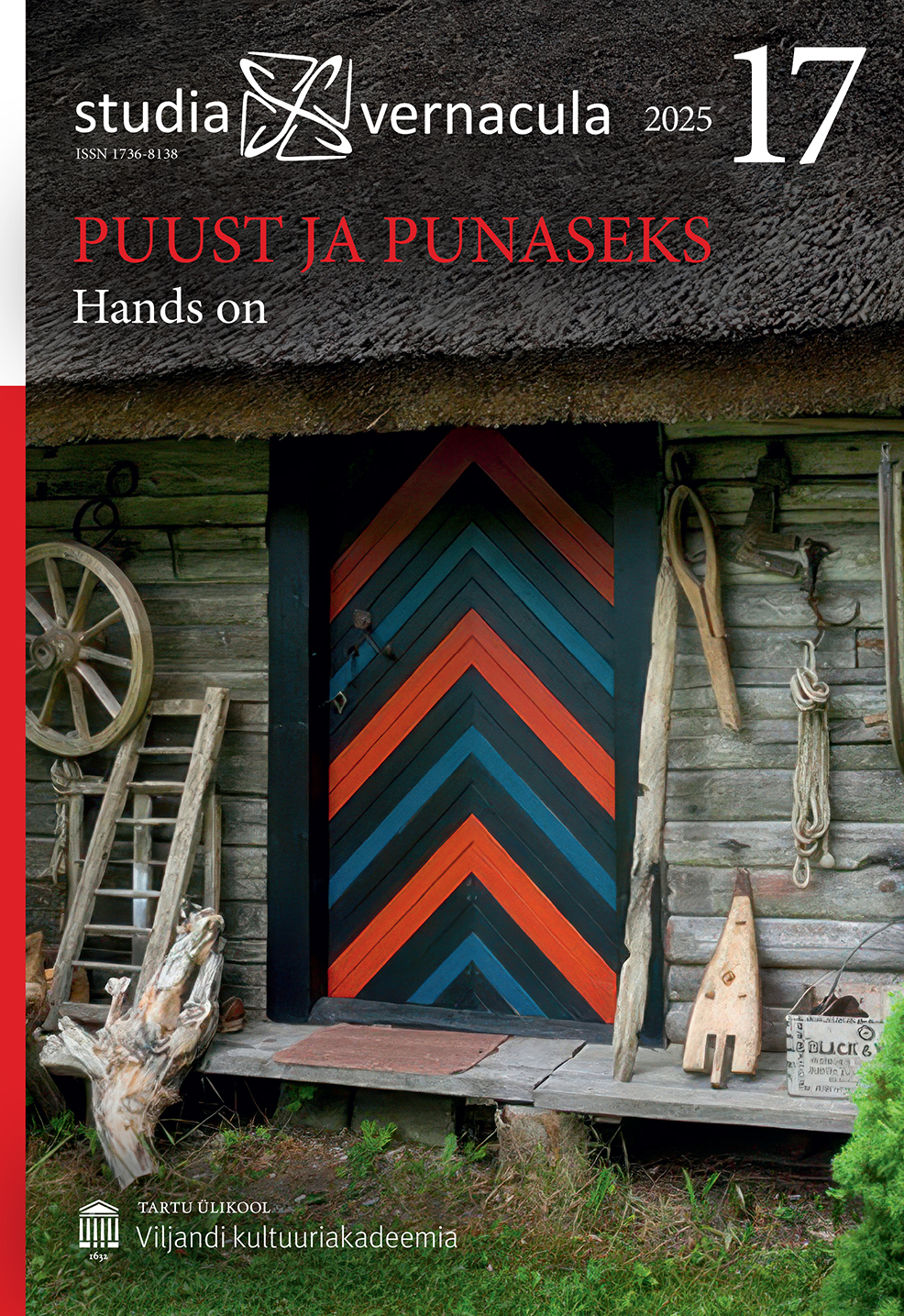
Ritsu rehemaja katuseharja uuendamise planeerimisest Eesti Vabaõhumuuseumis
DOI:
https://doi.org/10.12697/sv.2025.17.256-263Abstract
At the beginning of 2025 the issue of the renovation of the Ritsu barn-dwelling roof ridge was raised at the Estonian Open Air Museum. The building, which now stands at the edge of the forest, was brought to the museum from Tinnikuru village near Lake Võrtsjärv.
The Estonian Open Air Museum has an ethnographic description of the dwelling – EVM EA 43, originally compiled by Gea Troska – that includes a description of its history and construction. This reveals the building was built in the 1860s. The restoration of the Ritsu barn-dwelling kept this in mind, leaving out the chimney and – as a later addition to the original building – attached stable. When brought to the museum in 1966, the Ritsu barn-dwelling had a shingle roof, dated to 1938. Prior to that the roof was thatched, but no information as to what exactly it looked like exists now. The first place to look for examples is MUIS, where searches were carried out by both region and photographer. The limit set for the search was 1960, as the number of photographs increases considerably from there on and the likelihood of finding photographs depicting surviving thatched roof exam ples is minimal. The Estonian National Museum’s collection of ethnographic drawings was reviewed, with the limit set to 1940, as well as some ethnographic descriptions from south Estonia. Unfortunately, no photographs or drawings of thatched roofs were found for Paistu parish. As no examples were found for Ritsu’s roof in Paistu, the geographically and chronologically closest examples are photographs taken by Johannes Pääsuke in 1912 near Tarvastu.
A nationwide search discovered 12 more photos of roof ridges of a similar design in south Estonia. Examples closest to Ritsu are photos taken by Ilmar Linnat in 1949 on the other side of Lake Võrtsjärv, in Uniküla in Rannu parish. Other examples were found farther from Lake Võrtsjärv, in the parishes of Kursi, Rõuge, Urvaste, Võnnu, Räpina and Setumaa. In addition, as a student, architect Harald Sultson made a drawing of the barn-dwelling at Hiire farm in Kääpa village (ERM EJ 30:1) during ERM’s fieldwork in 1926, depicting bundles of straw tied to rods on the ridge and the derelict roof of the building.
A common feature to all these roofs is the absence of wooden strengthening for the ridge. Zooming in on the photos, a rod can be seen with the straw that’s broken over the ridge tied underneath, and a bundle of straw attached to the rod to protect the ties.
It is likely that from the autumn of 2025, the roof ridge of the Ritsu barn-dwelling in the Estonian Open Air Museum will be seen covered by these bundles of straw instead of the current wooden strengthening.
Downloads