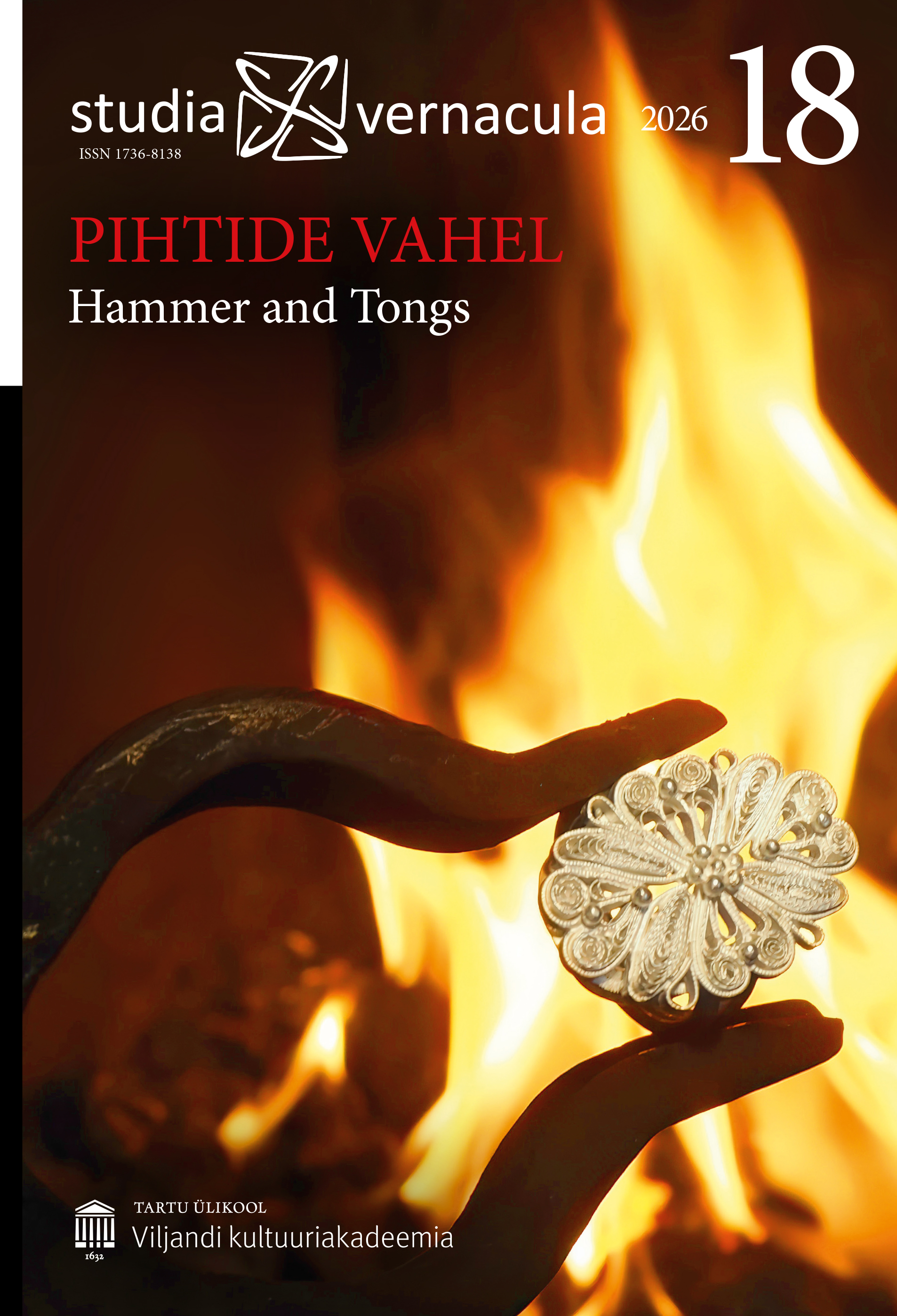
Eesti filigraan. Ühe kullassepatehnoloogia kohalike eripärade kujunemine 1920.–1930. aastatel / Estonian Filigree: The Development of Local Characteristics in Goldsmithing in the 1920s and 1930s
Abstract
This article examines the development of Estonian filigree as a phenomenon in the fields of jewellery art and technology in Estonia during the 1920s and 1930s. It discusses how the interplay of international influences, art education, local nationalist ideology and technological innovations gave rise to an Estonian approach to filigree that can be regarded as a distinct tradition in its own right. The study draws on archival sources, museum collections, periodicals and art historical literature.
Traditional filigree is based on spirals, loops and rosettes formed from wire that are used to decorate jewellery. A significant shift in European filigree techniques took place in the early 19th century, when a new sub-style of filigree, cannetille filigree, emerged in France, northern Italy, Austria and England. The distinctive feature of this technique lay in the use of threaded wire, which made it possible to create jewellery with more relief and a richer surface texture. From this cannetille tradition, Estonia’s own school of filigree developed in the 20th century.
The State School of Applied Arts played a central role in the development of Estonian filigree, as it was there that metalwork began to be taught systematically when a metalwork class was opened in 1925. The first head of this department was Klara Zeidler, an artist of Baltic German origin. She was one of the most important figures in the history of Estonian filigree. Zeidler had studied at the Stieglitz School of Applied Arts in St Petersburg and furthered her skills in Germany, Austria, England and elsewhere in Europe. Thanks to these studies, she was introduced to the cannetille filigree technique, which had not previously been known in Estonia. Upon her return to Estonia, she began to apply this knowledge in her teaching of metalwork. Presumably during the 1930–1931 academic year, the workshops at the State School of Applied Arts switched to using threaded wire. This was asignificant innovation, as the simpler wirework practised until then evolved into a more intricate, complex and artistically diverse form of filigree. The introduction of this technology laid the foundations for the development of a distinctive Estonian style of filigree.
The programme of study at the School of Applied Arts was comprehensive, encompassing drawing, composition and stylisation, with a particular emphasis on the application of traditional ornamentation. The album Estonian Folk Costume and Ornament, compiled by the school’s director, Voldemar Päts, was a particularly influential publication, through which motifs from folk art found their way into contemporary applied art. The utilisation of ornaments drawing inspiration from the floral embroidery of northern Estonia commenced in the design of filigree jewellery. The employment of lines and patterns, which are fundamental to both embroidery and filigree, rendered these motifs well-suited to the novel technique. Consequently, filgree assumed a pivotal role in the pursuit of a distinct national style within the context of Estonian art.
At the 1937 Paris World Exhibition, Ede Kurrel and Edith Holm exhibited their filigree jewellery, for which they were both awarded silver medals. This was a significant recognition both for the artists and for Estonian applied art as a whole. The success of the Estonian artists in this field served to confirm that the approach to filigree that had developed in Estonia was, both artistically and technologically, on a par with the finest examples in Europe. The spread of filigree was also supported by active commercial activity. OÜ Kodukäsitöö played a major role, marketing Estonian applied art both at home and abroad. Filigree jewellery was also produced in various studios and private workshops. Of particular importance was the Ormesson sisters’ fashion and applied arts workshop, where Ede Kurrel taught filigree and mentored new masters.
By the mid-1930s a relatively uniform technical and aesthetic approach had emerged, which can be described as ‘Estonian filigree’. Its main characteristics were the use of threaded wire, relief-formed spirals and rosettes, the creation of repeating symmetrical patterns using special steel frames, the soldering of elements from the underside of the jewellery, and the pickling of finished pieces in sulphuric acid to achieve a white finish. This gave the jewellery a light, matt finish, which Ede Kurrel associated with the aesthetics of a snowy Nordic landscape. Estonian filigree was particularly prized for its rich relief and delicate patterns, which set it apart from many other filigree traditions.
Keywords: Estonian filigree, jewellery art, goldsmithing techniques, State School of Applied Arts, Klara Zeidler, Ede Kurrel, applied art of the 1930s
Downloads