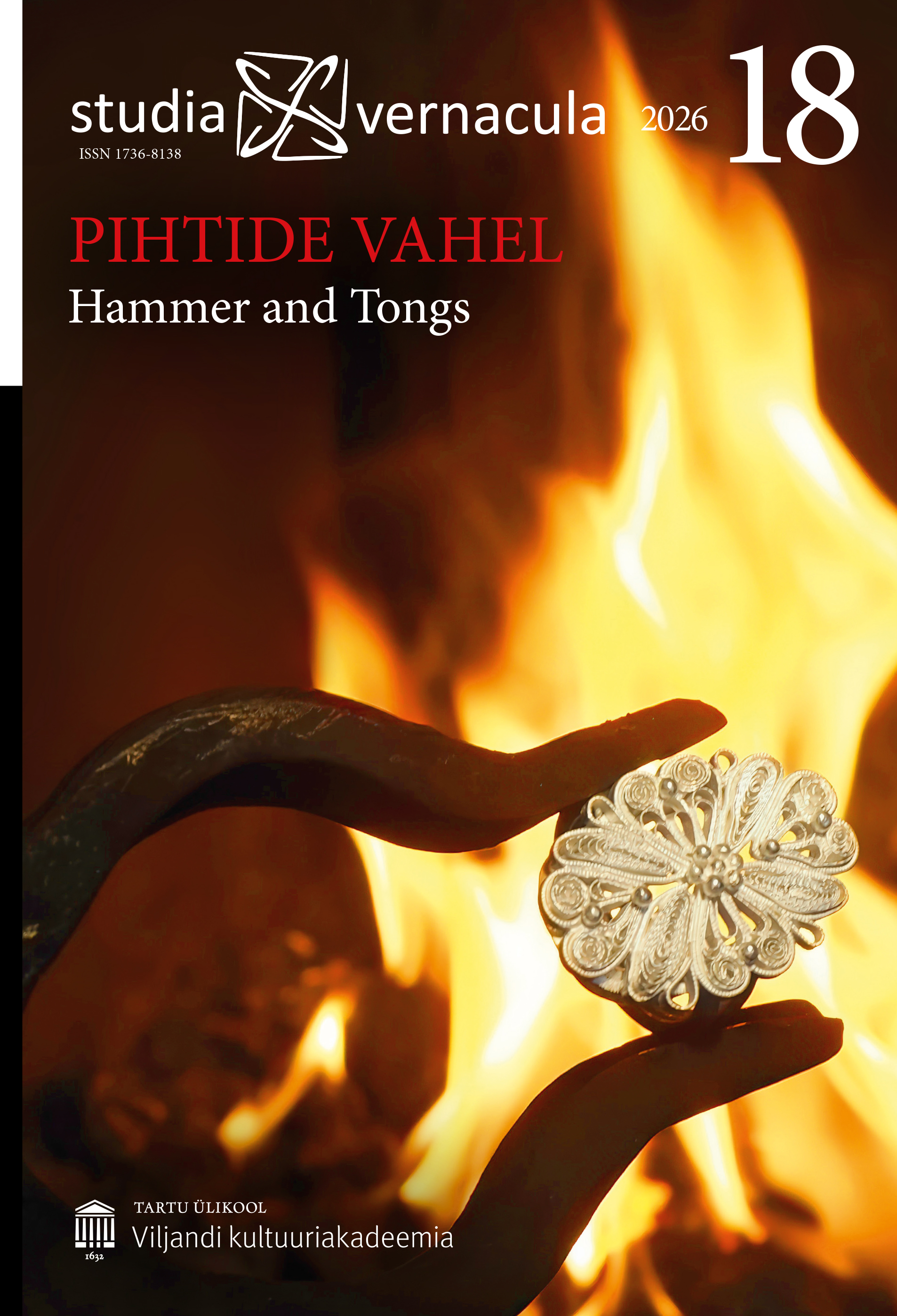
Rohkem kui ehe: Peeter Rooslaiu prossid Kihnu elavas pärandis / More Than an Ornament: Peeter Rooslaid’s Brooches in Kihnu Living Heritage
Abstract
The article examines the brooches made by the craftsman Peeter Rooslaid (1891–1976) in the context of Kihnu material culture and living heritage. Although Kihnu culture has been extensively studied through its textile traditions, folk costume, and strong communal continuity, considerably less attention has been paid to jewellery as a meaningful component of local materialculture. Rooslaid’s brooches offer an opportunity to explore how material objects participate in the construction of identity, memory, social relationships, and heritage practices within a small island community.
Originally from the island of Ruhnu, Rooslaid and his brooches became particularly popular among the people of Kihnu during the 20th century and gradually acquired an important place within local dress traditions. Characterised by layered construction, openwork designs, and carefully engraved motifs the brooches reflect both local maritime culture and broader cultural influences circulating in the Baltic Sea region.
The study combines several methodological approaches, including semi-structured interview, archival research, autoethnography, and practice-based enquiry. I occupy the dual position of researcher and community member, allowing for a reflexive insider perspective on the meanings attached to Rooslaid’s work. This position provides access not only to local knowledge and personal experience but also to the emotional and socialdimensions through which heritage objects are understood and valued. The article therefore contributes to discussions surrounding positionality, insider research, and the role of personal experience in ethnographic enquiry.
A central focus of the research concerns the social and cultural meanings associated with Rooslaid’s brooches in Kihnu. Fieldwork revealed that these objects function not merely as decorative ornaments but as carriers of memory, family continuity, and community belonging. Brooches have often been given as gifts to mark important life events such as graduation, marriage, and other significant transitions. Through gifting and inheritance they become embedded in personal biographies and family histories, acquiring meanings that extend far beyond their material value. The study demonstrates how these objects operate as mediators of social relationships and as material expressions of collective identity.
An important component of the research involved the creation of a contemporary interpretation of a Rooslaid brooch. Initially intended as an exact reconstruction, the project gradually evolved into an authorial interpretation inspired by the original designs. This shift prompted broader reflections on the relationship between tradition and creativity in craft practice. The practical making process enabled a deeper understanding of Rooslaid’s technical skills, working methods, and embodied knowledge while simultaneously highlighting the limitations of reconstruction when original tools, materials, and experience cannot be fully replicated.
The practice-based experiment demonstrated that knowledge about material culture is generated not only through observation and analysis but alsothrough direct engagement with materials and manufacturing processes. Working with metal, engraving techniques, and decorative motifs provided insights into the physical and cognitive dimensions of craftsmanship that would have remained inaccessible through textual sources alone. The com parison between my work and Rooslaid’s originals further revealed the sig- nificance of experience, repetition, and tacit knowledge in the development of craft expertise.
The findings suggest that Rooslaid’s brooches function as meaningful cultural objects whose significance extends beyond their decorative value. Through use, exchange, and inheritance, they mediate personal and collective memories, reinforce social ties, and contribute to the continuity of Kihnu’s living heritage. The article argues that Rooslaid’s work can be understood as an example of living heritage whose vitality relies on continued practice, reinterpretation, and transmission across generations.
Keywords: Peeter Rooslaid, Kihnu, material culture, living heritage, autoethnography, craft tradition, practice-based research, interpretation
Downloads