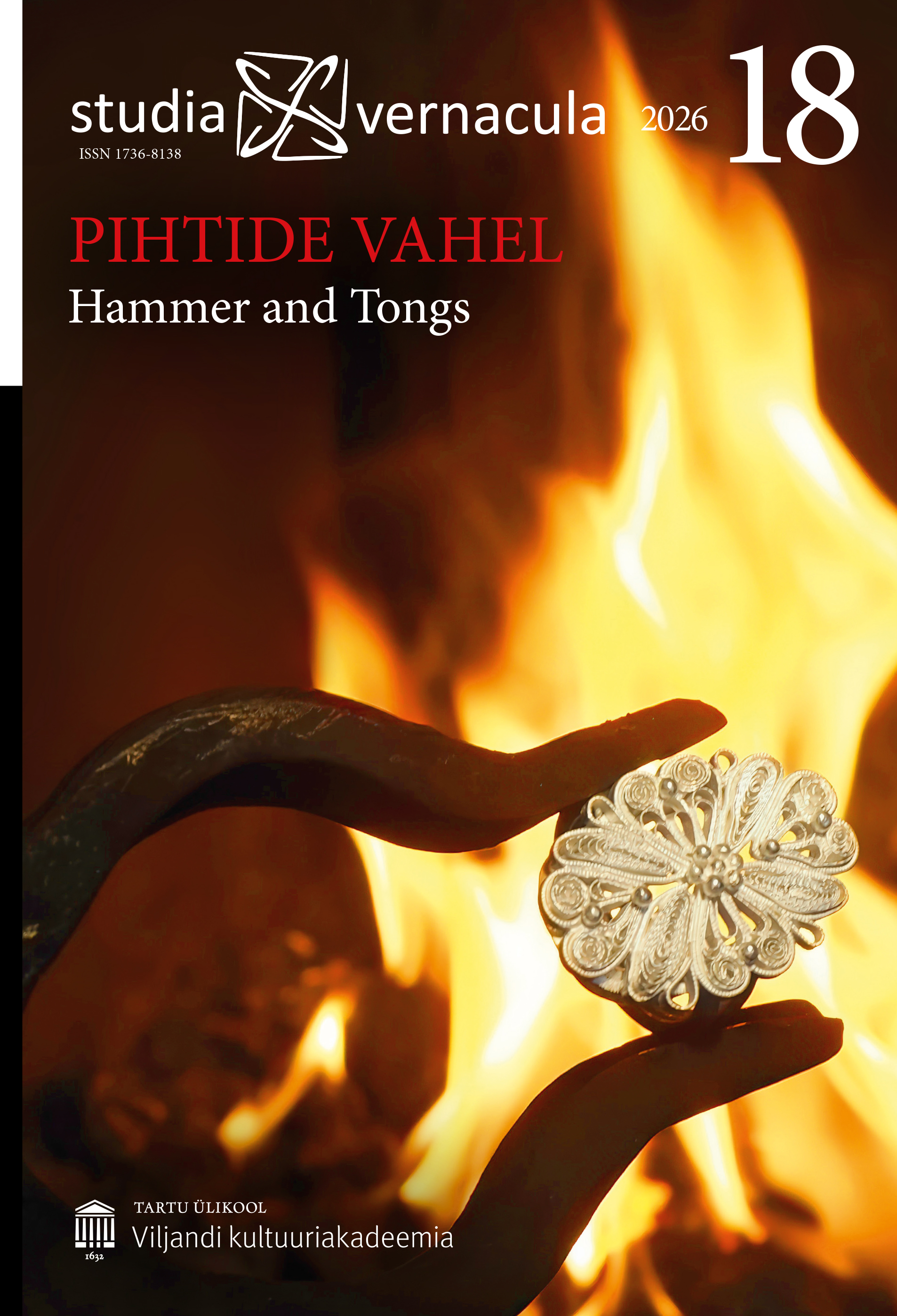
Põltsamaa preesi jälgedes: kadunud töövõtete taasavastamine ja tööriistade valmistamine / Rediscovering Lost Techniques for Making Põltsamaa-type Brooches and Toolmaking
Abstract
In late 18th and 19th century Estonia, Põltsamaa-type brooches were one of the festive adornments worn by peasant women. This article focuses on the reconstruction of the tools used to craft these brooches and on practical testing of their functionality. The article addresses the problem of no historical tools surviving and no written sources describing either their manufacture or their use. Although the external appearance of the brooches is well known, the technological aspects of their making have not yet been studied. This research is based on an object-based analysis, drawing on the tool marks found on the surfaces of brooches preserved in museums. The aim of practical testing was to determine which tools and techniques might have beenused to make the historical brooches. I created functional tools and a prototype based on this analysis.
In the mid-19th century, Põltsamaa-type brooches were made from silver or Neusilber (a copper-nickel-zinc alloy) sheet. The characteristic features of the Põltsamaa-type brooch were a serrated edge, a large diameter (ca. 7–11 cm) and symmetrical patterns on the surface. A relief ornament was applied to their surface using the metal stamping technique (Est. puntsimine). The ornament was created by striking the surface of a metal plate with special metal stamps (Est. punts) to form various indentations, floral and leaf motifs, lines and dots.
I documented and measured dozens of artefacts and compiled an over view of more than 80 Põltsamaa-type brooches preserved in museums and private collections. The research was based primarily on brooches held in the collections of the Estonian National Museum. A detailed examination of the ornamentation made it possible to identify recurring patterns and to infer which tools had been used to create them. I treated the marks left by the stamps as a kind of ‘fingerprint’ of the tools, which made it possible to
reconstruct the shape and operating principles of historical tools.
In making the tools, I used modern technical equipment, although the aim was to replicate the historical tools as accurately as possible. K510 tool steel was chosen as the material, as it combines good machinability, durability and ease of hardening. I produced several types of stamp and chisel based on the patterns found on the brooches. For example, a special stamp was created to strike round indentations, a stamp featuring a floral motif, and various flat and curved tools to shape lines and ornaments. In addition,
chisels were made to carve the jagged edge characteristic of brooches.
Making the tools turned out to be a time-consuming and exacting process. The performance of the tools produced was tested on silver and Neusilber sheets of varying thicknesses. The tests were carried out on various surfaces using hammers of different weights in order to determine the most suitable working conditions. A solid blacksmith’s anvil proved to be the best surface for hammering, as it dampened vibration and allowed the full force of the blow to be transferred to the metal. It also became clear that the size of the tool must correspond to the weight of the hammer being used: heavier hammers were suitable for striking larger patterns, whilst lighter and more precisely controllable tools were better for smaller details.
Tests were also carried out to identify the most suitable materials. In the case of silver sheet, the best results were achieved with material 0.5–0.6 mm thick, which was strong enough whilst still being easy to work with. For Neusilber, a thickness of approximately 0.8 mm proved to be the most suitable. These dimensions made it possible to achieve the clear and deep relief characteristic of historical brooches without excessive deformation of the material.
The culmination of the tests was the creation of a prototype brooch. All the knowledge gathered and tools developed during the experiments were utilised in its production. The prototype was not a replica of any specific museum exhibit, but rather an interpretation of historical technology and design principles.
The main conclusion of the study is that, even without surviving tools or written instructions, it is possible to reconstruct significant knowledge of historical craft techniques on the basis of traces found on the artefacts. The shape, finish and method of use of a tool directly influence the pattern left on the metal. These factors offer insight into the working methods employed by the artisans of bygone eras. This practical craft research not only helped to produce functional tools and a brooch modelled on a historical example, but also provided a broader understanding of the technological heritage of traditional metalwork.
Keywords: Põltsamaa-type brooch, peasant jewellery, reproduction of tools, metal stamping, chisels, silver, metalworking techniques
Downloads