Dear reader
DOI:
https://doi.org/10.12697/JI.2025.34.00Abstract
Dear reader,
Since its establishment, Juridica International has served as a distinctive forum for scholarly engagement with Estonian law in a broader European and international context. Originating as an international counterpart to the Estonian-language Juridica, the journal’s mission has undergone considerable evolution. Today, Juridica International is a well-established peer-reviewed law journal that combines rigorous doctrinal analysis with openness to comparative, interdisciplinary, and forward-looking legal research. At the same time, it continues to fulfil its core function: providing analytically grounded insight into developments within the Estonian legal order for an international readership.
This dual orientation is closely linked to the role of the Faculty of Law of the University of Tartu. As the leading centre of legal scholarship in Estonia, the Faculty has long shaped national legal discourse through research, teaching, and engagement with legal practice. Juridica International forms an integral part of this institutional framework. It offers a platform where debates on Estonian law are articulated in a manner that meets international academic standards and invites dialogue beyond national borders. In this sense, the journal not only reflects legal developments but actively contributes to the formation and critical assessment of Estonian law within the wider European legal space.
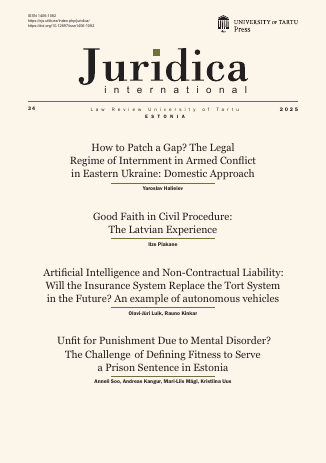
The present volume continues this established direction. The contributions span a broad range of legal fields and approaches, yet several thematic clusters emerge. A number of articles address questions of private law and procedural justice, focusing on principles such as good faith, efficiency, and legal certainty, while examining the evolving balance between party autonomy and the court’s role in civil proceedings.
Another group of contributions engages with public law and regulatory frameworks, particularly where national legislation intersects with European Union law. Public procurement serves as a focal point in this respect, highlighting the tensions between discretion, proportionality, and regulatory constraints in the national implementation of EU directives, as well as the practical consequences of legislative design choices.
Technological development and digitalisation constitute a further prominent theme. Several articles analyse how artificial intelligence, digital procedures, and technology-driven transactions challenge established legal concepts. These contributions critically assess whether existing liability, insurance, and intellectual property frameworks remain adequate in an increasingly automated and data-driven environment.
Issues of criminal law and human rights also feature prominently. Questions concerning punishment, detention, and state power are examined in light of constitutional guarantees and international legal standards, highlighting the interaction between security considerations, human dignity, and the limits of lawful state intervention.
Taken together, the articles in this volume demonstrate Juridica International’s continued commitment to analytical depth, doctrinal precision, and critical inquiry. They illustrate how Estonian legal scholarship engages simultaneously with domestic legal challenges and broader European and international debates. Juridica International thus remains a key forum through which the Faculty of Law of the University of Tartu upholds and advances informed, internationally relevant discussion of Estonian law, while contributing meaningfully to global legal scholarship.
Downloads